From Seawater Intake to Utility Distribution: Where Microbes Thrive Offshore

08 Oct 2026
Why seawater lift pumps are ground zero for offshore biofouling.
Every litre of seawater brought onto an offshore platform contains millions of naturally occurring marine microorganisms, including bacteria, archaea, algae, fungi and microscopic plankton. While these organisms pose little threat in the open waters, conditions change dramatically once seawater enters engineered systems.
Within pipelines, pumps and process equipment, microorganisms encounter artificial surfaces, altered flow conditions and varying concentrations of oxygen and nutrients. These changes encourage microbial attachment, the development of biofilms and, in some cases, microbiologically influenced corrosion (MIC). Left unmanaged, microbial activity can contribute to fouling, reduced equipment performance, corrosion and increased maintenance costs.
Where the Journey begins – SW Intake and Lift Pumps
The seawater intake is the entry point for every microorganism that will travel through the platform's seawater systems. Along with marine bacteria, seawater also carries suspended solids (TSS), organic material, algae and small marine organisms that provide both nutrients and surfaces for microbial attachment.
Lift pumps transport this seawater into the processing system. These represent the first engineered surfaces encountered by microorganisms. Pump casings, pipework and intake structures are continually exposed to fresh microbial populations, making them susceptible to marine growth and the early stages of biofilm formation (see image).
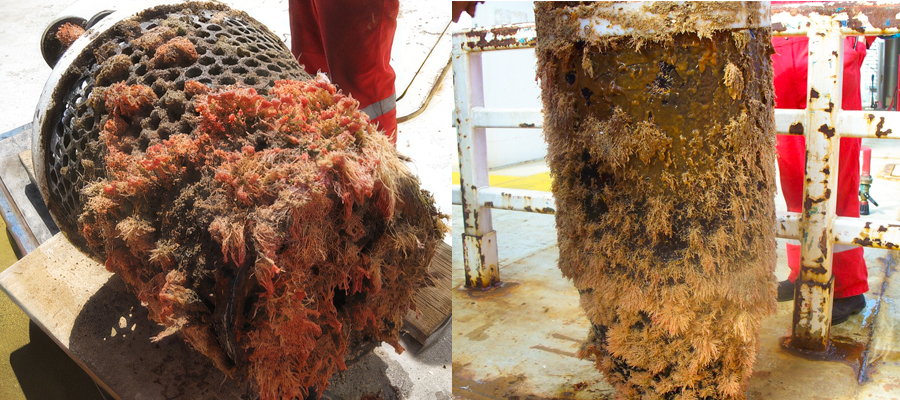
Images of marine growth on lift pump basket
Whilst the focus is often on the consequences of microbial activity downstream, microbial communities might already establish themselves at the intake. The extent to which these communities develop depends on factors such as seawater quality, stand-by operation, seasonal variation (e.g. algae and planktonic blooms), flow velocity, residence time and existing treatment programmes.
Understanding the microbial challenge at this early stage provides valuable context for managing the rest of the seawater system.
The Different Routes of Seawater
Once lifted from the sea, seawater is distributed to several systems across an offshore installation, each with its own operational objectives and microbial risks.
The largest proportion is typically directed towards water injection, where extensive treatment—including filtration, deaeration and chemical dosing—is used to protect the reservoir and minimise corrosion within injection infrastructure. - read our blog Deaerator Tower: A perfect breeding ground for Microbes?
Other seawater streams are supplied to utility systems, including cooling water, firewater, equipment washdown and general utility service water. These systems often operate under very different hydraulic conditions, with varying flow rates, temperatures and periods of stagnation. Consequently, the microbial communities that develop within them can differ significantly from those found in injection systems.
Although each system has different operating conditions and treatment requirements, they all originate from the same seawater source, meaning microbial populations evolve as water moves through the platform.
Filtration: Reducing the Load on Downstream Systems
Filtration is the first major treatment barrier after seawater enters the platform. Its primary role is to remove suspended solids, marine debris and larger particulates, protecting downstream equipment from erosion, plugging and fouling while reducing the amount of material available for microbial attachment.
However, filtration does not sterilise seawater. Most bacteria pass through conventional filters, despite this when large amount of biomass enters the system (such as during algae blooms) filters can also become sites of microbial growth. The large surface area within filter vessels provides an ideal environment for bacteria to attach, utilise nutrients from the passing seawater and form biofilms if filters are not effectively managed.
For this reason, filtration is complemented by oxidising biocides, such as electro-chlorination or sodium hypochlorite typically added to the lift system, and where appropriate, non-oxidising biocides to control established biofilms. In some cases, a combined approach is taken adding chlorine and silver dosage.
Neither filtration nor biocide treatment alone provides complete protection. Effective microbial control depends on understanding the operating conditions, maintaining appropriate disinfectant residuals, and monitoring the system using microbiological, corrosion and process data—not simply microbial numbers—to ensure treatment programmes remain effective.
Monitoring Beyond Microbial Numbers
One of the most common misconceptions in offshore microbiology is that microbial risk can be assessed simply by measuring the number of microorganisms present.
In reality, microbial cell numbers are only one piece of the puzzle. The complex relationship between planktonic counts, biofilms, filtration performance, and corrosion deserves its own discussion—which we'll cover in future blogs.
Effective microbial monitoring therefore combines multiple lines of evidence. Alongside microbial enumeration, operators should consider microbial activity, biofilm formation, solids control, water chemistry, corrosion monitoring, disinfectant residuals, operating conditions and overall process performance. Increasingly, molecular techniques are also providing greater insight into microbial community composition and the organisms most likely to influence corrosion and fouling - read our blog: Microorganisms in the oilfield – wanted dead or alive?
By integrating microbiological data with corrosion and process information, operators can build a much more complete picture of microbial risk than microbial counts alone can provide.
Why Location Matters
Not every part of the seawater system presents the same microbial challenge. Factors such as flow velocity, oxygen availability, nutrient concentration, temperature, residence time and treatment effectiveness all influence where microorganisms are most likely to establish and persist.
| System Area | Typical Microbial Risk | Main Operational Concern |
| Intake | High organism loading | Marine growth |
| Lift pumps | Moderate | Performance loss |
| Filters | High | Filtration performance |
| Cooling water | Very high | Biofilms and MIC, Delta Heat Reduction |
| Firewater | High during stagnation | Corrosion and reliability |
| Utility | High | Biofilm accumulation |
Recognising these differences allows monitoring and treatment strategies to be targeted where they will have the greatest operational benefit.
Key Takeaway
Microbial risk begins the moment seawater enters the platform, not when corrosion or fouling becomes visible. Successful management requires more than routine biocide dosing or microbial counts—it requires understanding how microorganisms respond to changing conditions throughout the seawater system. By integrating microbiology, corrosion and process data, operators can target treatment more effectively and reduce the risk of MIC, biofouling and unplanned downtime.
Get informed
Boost your own knowledge in oilfield microbiology with our two-day Oilfield Microbiology course on in Aberdeen, UK. Contact us to enquire about dates.